My Story
A few stations, a few images in my mind, and an attempt to explain what photography won't let go of in me. In German and English.
The Nature of Being Human
It started with a misunderstanding. In 2018, Casey Neistat had me hooked – his light, playful way with images and stories. I bought the camera he used, set it up, started streaming. And realised right away: speaking into a camera felt wrong. I had spent a small fortune trying to be someone I wasn't.
So I turned the camera around.
The first assignment came a few months later: social media photos for a friend's restaurant. What began as a favour became my first real insight. I didn't photograph the dishes, but the people behind them – cooks, waiters, kitchen hands. People you barely notice as a guest. Inconvenient hours, often little recognition, and yet this quiet devotion to what they do. Back then I couldn't have put it into words, but looking back, that was the moment my eye found a direction: I wanted to show the people who usually go unseen.
Two years later, in the spring of 2020, I walked through an empty Düsseldorf. On the Kö, backlit, facing west – the Breidenbacher Hof on the left, the Kaufhof on the right, and nothing in between. The pandemic had brought the city to a standstill. What captivated me wasn't the emptiness itself, but how the few passers-by moved through it: keeping their distance, full of suspicion, as if they had become strangers to one another overnight. I felt like I was watching a city that no longer knew what it was. In those weeks, I understood for the first time, photographically, that people don't have to be in the frame to be the subject.
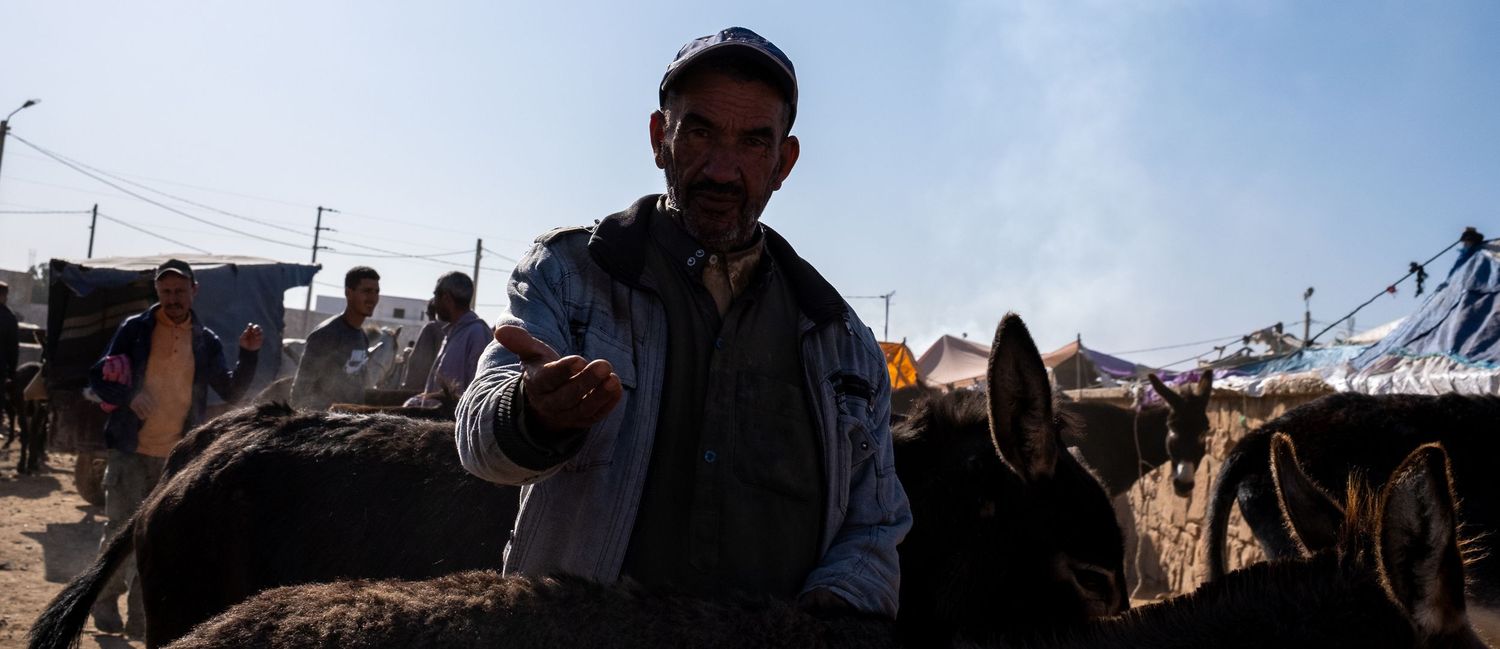
In 2024, I travelled to Morocco with my wife. At a local weekly market in Had Draa, I wore my camera openly around my neck with the shutter release tucked into my pocket. That way I could observe without photographing in the traditional sense – catching any moment, whenever I felt like it. Just after we arrived, a man reached out his hand to me across his donkey, in a gesture I read as a question: If you want a photo, give me something in return. He couldn't see that I had already pressed the shutter. The image is a technical failure; his face disappears into shadow. And yet it's one of the photos I think about most. Perhaps because it captures so precisely what I'm looking for in this kind of photography – and what makes it difficult at the same time.
These days I read up on photographic theory, spend hours leafing through photo books, attend workshops. I already knew Cartier-Bresson and Fan Ho; since then I've added Vivian Maier, Bruce Davidson, Joel Meyerowitz, Gustavo Minas, Bruce Gilden – and Sebastião Salgado, whose Gold hasn't let go of me. Some of them I admire, others I quarrel with. Both help to sharpen one's own eye.
Despite the years with a camera, I feel as though I'm only just at the beginning. I'm trying to fathom the nature of being human. Nothing more, really. And nothing less.
Das Wesen des Menschen
Angefangen hat es mit einem Missverständnis. 2018 hatte mich Casey Neistat gepackt – sein leichter, spielerischer Umgang mit Bildern, mit Geschichten. Ich kaufte die Kamera, die er benutzte, baute sie auf, startete den Stream. Und merkte sofort: Vor der Kamera zu sprechen, fühlte sich falsch an. Ich hatte mir teure Ausrüstung gekauft, um jemand zu sein, der ich nicht war.
Also drehte ich die Kamera um.
Der erste Auftrag kam ein paar Monate später: Social-Media-Fotos für das Restaurant eines Freundes. Was als Gefallen begann, wurde zur ersten echten Erkenntnis. Ich fotografierte nicht die Gerichte, sondern die Menschen dahinter – Köche, Kellner, Hilfskräfte. Menschen, die man als Gast kaum wahrnimmt. Ungünstige Arbeitszeiten, oft wenig Anerkennung, und trotzdem diese stille Hingabe an das, was sie tun. Damals hätte ich es noch nicht so benannt, aber rückblickend war das der Moment, in dem mein Blick eine Richtung bekam: Ich wollte Menschen zeigen, die sonst übersehen werden.
Zwei Jahre später, im Frühjahr 2020, lief ich durch ein leeres Düsseldorf. An der Kö, Gegenlicht, Blick Richtung Westen – links der Breidenbacher Hof, rechts der Kaufhof, und dazwischen nichts. Die Pandemie hatte die Stadt angehalten. Was mich gefangen nahm, war nicht die Leere selbst, sondern wie die wenigen Passanten sich darin bewegten: mit großem Abstand, mit Misstrauen, als wären sie einander über Nacht fremd geworden. Ich hatte das Gefühl, einer Stadt zuzusehen, die nicht mehr wusste, wer sie ist. Fotografisch verstand ich in diesen Wochen zum ersten Mal: Die Menschen müssen nicht im Bild sein, um das Thema zu sein.
2024 reiste ich mit meiner Frau nach Marokko. Auf einem lokalen Wochenmarkt in Had Draa trug ich meine Kamera offen um den Hals, den Auslöser in der Hosentasche. So konnte ich beobachten, ohne im klassischen Sinn zu fotografieren – jeden Moment einfangen, wann immer ich es wollte. Gleich nach unserer Ankunft streckte mir ein Mann über seinem Esel die Hand entgegen, in einer Geste, die ich als Frage verstand: Willst du ein Foto, dann gib mir etwas dafür. Er konnte nicht sehen, dass ich bereits auslöste. Das Bild ist technisch misslungen, sein Gesicht versinkt im Schatten. Trotzdem ist es eines der Fotos, an die ich am meisten denke. Vielleicht, weil es so genau zeigt, was ich an dieser Art zu fotografieren suche – und was sie zugleich schwierig macht.
Heute lese ich mich in Fototheorie ein, blättere stundenlang in Bildbänden, besuche Workshops. Cartier-Bresson und Fan Ho kannte ich schon, dazugekommen sind Vivian Maier, Bruce Davidson, Joel Meyerowitz, Gustavo Minas, Bruce Gilden – und Sebastião Salgado, dessen Gold mich nicht mehr losgelassen hat. Manche bewundere ich, mit anderen reibe ich mich. Beides hilft, den eigenen Blick zu schärfen.
Trotz der Jahre mit der Kamera habe ich das Gefühl, gerade erst am Anfang zu stehen. Ich versuche, das Wesen des Menschen zu ergründen. Mehr ist es im Grunde nicht. Und weniger auch nicht.